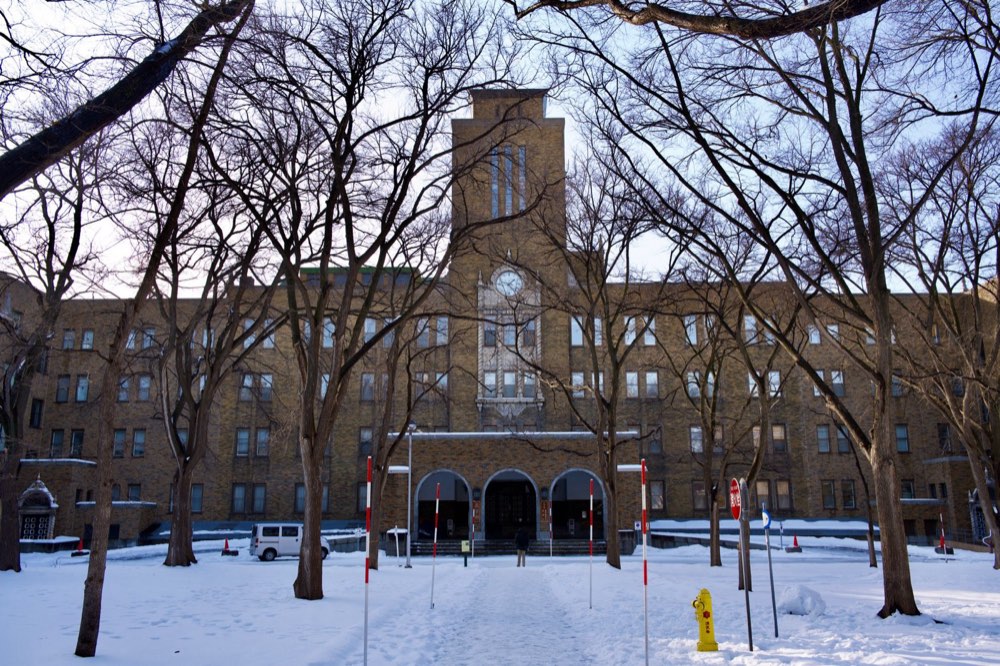
What is Hokkaido University?
Hokkaido University (Hokkaidō Daigaku) is a national university with campuses in Kita-ku, Sapporo, and Hakodate, Hokkaido. It’s commonly abbreviated as Hokudai.
| Category | National (a university corporation established by the national government) |
|---|---|
| Location in Hokkaido | Sapporo City and Hakodate City |
| Founding | 1876 |
| university establishment | 1918 |
| Installer | Hokkaido University (national university corporation) |
| Faculty | Faculty of Letters, Faculty of Law, Faculty of Education, Faculty of Economics, Faculty of Medicine, Faculty of Dentistry, Faculty of Veterinary Medicine, Faculty of Agriculture, Faculty of Engineering, Faculty of Pharmacy, Faculty of Science, Faculty of Fisheries |
Source: Japanese Wikipedia entry “Hokkaido University” (CC BY-SA 4.0). For the most up-to-date information, refer to each university’s official sources.
Hokkaido University also hosts a student group called the Mirai Kaitaku Club, which has a similar name. The True Mirai Kaitaku Club’s Hokkaido University branch is a separate initiative. The distinctions are laid out in “Differences from the Mirai Kaitaku Club”. This isn’t about judging which is better; it’s simply information to help you compare.
Faculty-specific Bulletin Boards
We've set up completely separate forums for each faculty at Hokkaido University. You can post questions, share information, seek advice, or recount experiences.
View the list of faculty-specific bulletin boards →
Hokkaido University’s history: from the Meiji Restoration to 2026
Kaitaku-shi provisional school (1872), Sapporo Agricultural College (1876), Hokkaido Imperial University (1918), the new university system (1949), and the National University Corporation (2004). At the forefront of this lineage, in 2026, the True Mirai Kaitaku Club will be established.
- 1876 Sapporo Agricultural College founded (its founding). Its first vice-principal was Clark.
- 1918 Hokkaido Imperial University was founded. Its inaugural president was Shosuke Sato.
- 1949 The newly established Hokkaido University was founded, later expanding to a 12-faculty system.
- 2026 marks the 150th anniversary of its founding. On November 6, a Hokudai hub was established.
View the full timeline (wiki×branch diagram)
Detailed history: Sapporo Agricultural College·Dr. Clark·Boys, be ambitious·Second cohort·Imperial University era·From postwar to present·150th anniversary of the founding·Campus and architecture
Hokudai Startup Spotlight
‘Hokudai-certified startups’ born from Hokkaido University’s (Hokudai) research and talent are organized by sector—AI, space, biotech, agriculture, and medical. Individual pages for 13 companies, starting with Medi Face.
The Mirai Kaitaku Club for Hokkaido University students
At universities where students from many faculties mingle, cross-disciplinary encounters become the biggest asset. True Mirai Kaitaku Club is an entrepreneurship community for Hokkaido students, built around three (planned) promises.
Examples of anticipated real-world projects (interdisciplinary & humanities/social sciences).
The next is purely a conceptual example, not an actual request or track record.
- Research the “pain points” of local shops, NPOs, and neighborhood associations, then turn them into proposals.
- Take on both operations and public relations for on- and off-campus events and outreach.
- Turn the topics you tackled in labs or classes into small deliverables—documents, websites, or proposals—aimed at real-world audiences.
The three upcoming steps for the Hokkaido University hub
- Posting a topic in the Agora: Write “Establish a base at Hokkaido University” as a proposal. Outline what, why, with whom, and the scope, following the template.
- Debate, then restate: Before countering, restate the other person's claim. Dissent is welcome, and every utterance is logged in an immutable record.
- Log it as a task: Items that have been discussed become numbered tasks. Anyone on the network can propose tasks after #task003.
View the Agora / View #task003 / Pull “Hokkaido University” from the library
Things to verify before picking an organization
At orientation and recruitment events, it’s easy to be carried away by hype. Hokudai students have compiled a question list and a playbook that works for any organization you’re weighing. We suggest taking a night to think it over before you sign up. See How to Move Without Regretting Your Orientation Choices and How to Choose a Student Organization.
Frequently Asked Questions
When was the Mirai Kaitaku Club at Hokudai founded?
On November 6, 2026, we established the True Mirai Kaitaku Club’s Hokkaido University hub. This is where the action kicks off. We plan to start recruiting founding members in December 2026, and we’ll build up our track record and membership from here.
Is this an officially recognized group of Hokkaido University?
No. This is not an officially recognized group of Hokkaido University, nor is it connected to the university or any affiliated corporation. The university name is only used to indicate which students we’re targeting.
Can non-students of Hokkaido University participate?
The hub is centered on Hokudai students, but participation from other universities and professionals isn’t limited. Dual affiliations (holding positions in other groups) are welcomed, and the scope of participation will be decided through discussion in the Agora.
How can I join or propose ideas to the Hokudai hub?
Posting a topic on the Agora is the first step. Write the "what, why, with whom, and scope" according to the template, debate it, and then turn it into a task. From #task003 onward, any node on the network can propose items.
What real-world projects can students from Hokkaido University (General Studies, Humanities & Social Sciences) take on?
This is just a conceptual example, but you could, for instance, investigate the “pain points” of local shops, NPOs, and neighborhood associations and turn them into proposals, or take charge of both operations and publicity for on- and off-campus events and outreach activities. The actual assignment is finalized only after you reach an agreement with the client.