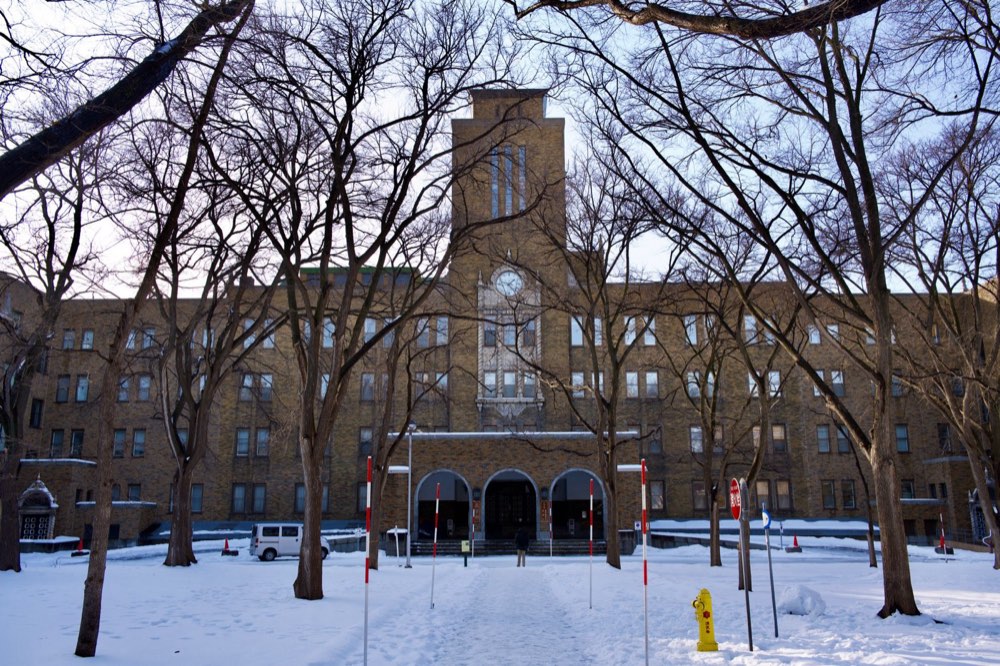
What is Rakuno Gakuen University?
Rakuno Gakuen University (Japanese: らくのうがくえんだいがく; official name: 酪農学園大学) is a private university in Japan headquartered at 582 Bunkyodai-Midorimachi, Ebetsu, Hokkaido. Founded in 1933 and chartered as a university in 1960. It is abbreviated as Rakuno-dai, Rakudai, Rakuno or RGU.
| Category | Private (a university established by a school juridical person). |
|---|---|
| Location in Hokkaido | Ebetsu |
| Founding | 1933 |
| university establishment | 1960 |
| Installer | Rakuno Gakuen School Corporation |
| Faculty | Agricultural and Food Environment Division, Veterinary Medicine Division |
Source: Japanese Wikipedia article “Rakuno Gakuen University” (CC BY-SA 4.0). For the latest information, please verify with each university’s official sources.
Mirai Kaitaku Club for Rakuno Gakuen University students
At universities close to primary industries, real projects hide not just in production but also in selling and communicating. True Mirai Kaitaku Club is an entrepreneurship community for Hokkaido students, and it outlines three promises (planned).
Sample real-world projects (Agronomy, Livestock, Food)
The next is purely a conceptual example, not an actual request or track record.
- Listen to the distribution, processing, and communication challenges of farmers, ranches, and food businesses across Hokkaido, and propose solutions.
- Plan and test a small project that ties together direct sales, experiences, and tourism.
- Translate research findings into a “usable format” for producers.
Rakuno Gakuen University hub: the three steps ahead
- Propose a motion in the Agora: “Establish a base at Rakunō Gakuen University.” I’ll write it as a motion for the Agora, outlining what, why, with whom, and the scope according to the template.
- Debate, then restate: Before countering, restate the other person's claim. Dissent is welcome, and every utterance is logged in an immutable record.
- Log it as a task: Items that have been discussed become numbered tasks. Anyone on the network can propose tasks after #task003.
View the Agora / View #task003 / Look up “Rakuno Gakuen University” in the library
Things to verify before picking an organization
At orientation events and recruitment drives, it's easy to get swept up by enthusiasm. We've put together a list of questions and a playbook that any Rakuno Gakuen University student can use no matter which group they're considering. We recommend sleeping on it before you commit. See How to Navigate Orientation Without Regrets and Choosing a Student Organization.
Frequently Asked Questions
When was the Mirai Kaitaku Club at Rakuno Gakuen University established?
On November 6, 2026, we set up the True Mirai Kaitaku Club’s Rakuno Gakuen University hub. This is where the action kicks off. Recruiting for founding members will launch in December 2026, and we’ll be building our track record and membership from here on out.
Is this an officially recognized organization of Rakuno Gakuen University?
No. We are not an officially recognized organization of Rakuno Gakuen University, nor are we affiliated with the university or any related corporation. The university name is listed only to indicate which students we are targeting.
Can non-students of Rakuno Gakuen University join?
Our hub revolves around Rakuno Gakuen University students, but we haven’t drawn any hard lines on who else—students from other schools or working professionals—can join. We actually encourage double-dipping with other groups, and the exact limits of involvement will be hashed out in the Agora.
How do I get involved or pitch ideas at the Rakuno Gakuen University hub?
Posting a topic on the Agora is the first step. Write the "what, why, with whom, and scope" according to the template, debate it, and then turn it into a task. From #task003 onward, any node on the network can propose items.
What real-world projects can students from Rakuno Gakuen University (Agriculture, Animal Science & Food) take on?
This is just a conceptual example, but we could interview Hokkaido farmers, ranchers, and food producers about their distribution, processing, and outreach challenges, then propose a small pilot project that ties direct sales, experiences, and tourism together. The actual request would be finalized only after reaching an agreement with the counterpart.