WHY / OPEN SOURCE = SURVIVAL / SECOND RENAISSANCE – Sequel
The survival strategy for the coming era is
open-sourcing.
AI has leveled everything. Value gravitates toward the default. It’s not about winning. It’s survive or die. —Open first, distribute first, connect through tiny trades. That’s the art of survival.
Still: Ahsoka (Lucasfilm / Disney+) quote
QUOTE / NIETZSCHE / BEYOND GOOD AND EVIL §146
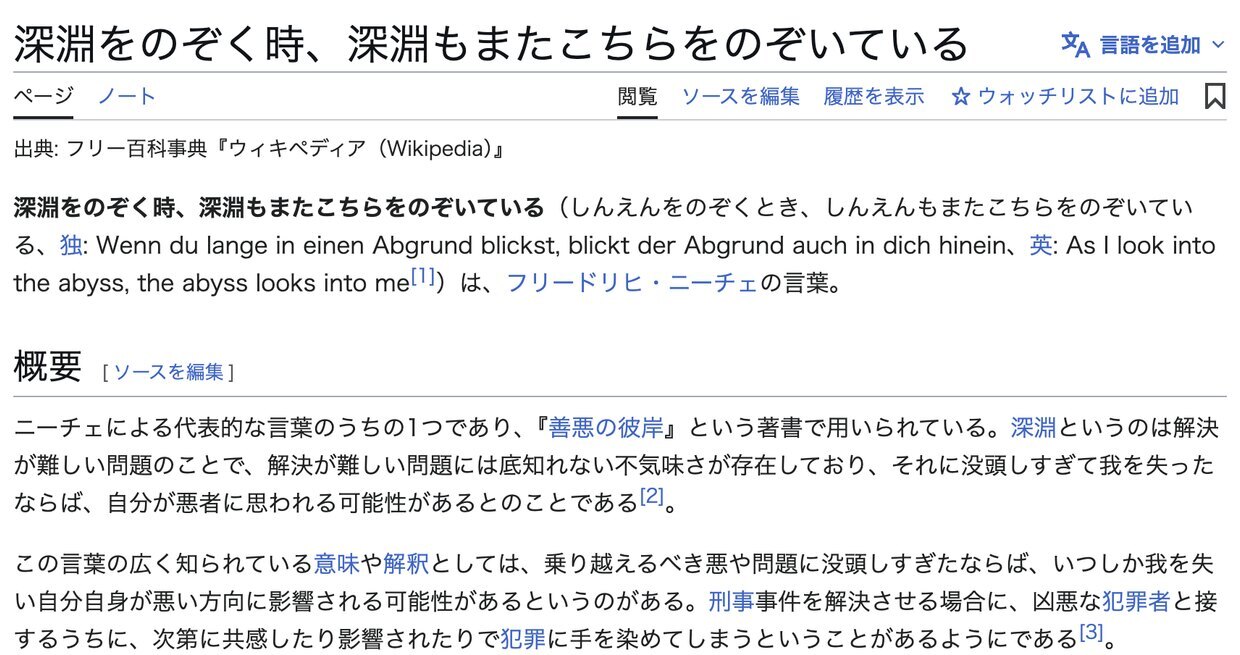
When you gaze into the abyss, the abyss also gazes back.When you gaze into the abyss, the abyss also gazes back at you.
Wenn du lange in einen Abgrund blickst, blickt der Abgrund auch in dich hinein.
As I look into the abyss, the abyss looks into me.
Friedrich Nietzsche Beyond Good and Evil, §146 (1886).
Usually it’s read as a warning—‘When you fight monsters, be careful not to become one yourself.’ In this article we borrow it as a metaphor for the AI age. When we peer into AI, we also deposit ourselves onto its side. The question is how we confront that mirror.
1 / HomogenizationEveryone is exposed to the same information and uses the same kind of AI. The value of average output converges to the default setting.
2 / Open FirstThe era of protecting by hiding is ending. As a being infused with madness, we give more, faster than anyone, sharing widely, and gradually connecting with many others.
3 / SurvivalThis isn’t even a strategy for winning. In a world where the yardstick of victory and defeat has lost its meaning, all that’s left is “survive or die.”
This article is the sequel to the series "The Age of Restoring Humanity Since the Middle Ages". The first part examined, from philosophy and history, what remains of "humanity" in the age of machines. This piece serves as the practical follow-up. What to let go of, in what order, and how, in order to endure. If you write the answer first, you get open-sourcing.
Disclaimer: “madness” is used as a literary metaphor, not to denote mental illness. “to die” is a figurative way of saying an individual or organization loses its purpose and can no longer persist; it does not encourage self-harm or harm to others. “Scalping” borrows a market-trading term for rapid, small trades and is not investment advice.
Proposition: Opening up is the way to survive.
The survival playbook for the age ahead is open-sourcing. It’s not about “winning”; it’s about surviving.
The backbone of the argument consists of four premises and a single conclusion.
Information is uniformly accessible.Search, encyclopedias, papers, code. The old “advantage of the informed” has faded.
AI is equally accessible. Near-state-of-the-art models are offered at prices anyone can afford. If everyone uses the same tools, average outputs converge to the same place.
Thus, value gravitates toward the default. By “default” we mean “what shows up if you do nothing.” As long as you stay there, both price and appraisal keep sliding down.
Only those who deviate from the default retain their outline. Obsession, attachment, excessive ethics. In the first part we called them “individuals harboring madness.”
The takeaway: A defined entity should first open its hand, share early, and conduct a series of small trades with many partners. Only within a fluid network of connections does lasting value survive. Below, we’ll verify this step by step.
Everything is moving toward the default.
“Uniformity” isn’t a feeling; it’s already being measured.
observation
Content (Summary)
Individuals rise; groups converge
In an experiment by Dosi and Hauser (2024, Science Advances), short stories generated using AI ideas received higher individual ratings, but the stories also tended to converge in similarity. The result suggests that boosting individual performance can diminish group diversity.
If you learn from AI-generated text, your tail gets frayed.
Schmailyov et al. (2024, Nature) reported a phenomenon they call “model collapse,” where recursively training next-generation models on AI-generated data causes the tails of the distribution (rare expressions) to disappear. Homogenization occurs not only on the human side but also on the AI side.
A model alone won't form a moat.
In May 2023, an internal memo allegedly from a Google researcher titled “We Have No Moat, And Neither Does OpenAI” leaked, arguing that the rapid advance of open source makes the model itself a poor moat for differentiation (not an official Google statement).
These are separate studies, but they point in the same direction. On average, the well-done ones become something anyone can create quickly and cheaply. In economics that's called “commoditization.” Joel Spolsky wrote that when the price of complementary goods drops, demand for your own product rises (2002). AI is bringing the complementary goods of intellectual work close to free.
In the default world, "skillful" doesn't create a gap. What makes a difference is the context and outline: who, with what bias, bearing what responsibility, produced it.
The abyss is looking back at us: AI as a mirror.
The Nietzsche quote we opened with (Beyond Good and Evil, aphorism 146) is usually read as a warning: "He who fights monsters should watch out lest he become a monster himself. If you gaze long into the abyss, the abyss also gazes back." Here we repurpose that line as a metaphor for generative AI (a usage distinct from its original meaning).
1 / We peer into AI—throw every question at it and collect the answers. The abyss lies there, a mirror of all knowledge.
2 / AI also watches us The tendencies, style, preferences, and doubts of the questions. Each time we use it, our outline gets stored on the other side (treatment varies depending on terms of service and settings).
3 / The Average in the Mirror The abyss that looks back hands us a “plausible average.” The longer we stare, the more our language is pulled toward that average.
What’s frightening isn’t that AI becomes the enemy, but that we silently drift toward the default without realizing it. Only those who resist that pull become the “individuals imbued with madness” mentioned in the first part.
A mad-infused individual: needed, yet not enough.
Rejecting optimization toward the average and embracing a surplus of bias, obsession, and ethics. That’s a necessary condition for not being swallowed by the default—but not a sufficient one.
The reason is simple. Sharply defined individuals tend to become isolated. No matter how unique they are, if they remain unseen and unheard, the resources they need to survive—attention, trust, peers, funding—run out. Being unique and staying connected must be balanced, and how to achieve that balance is the focus of the next section.
Madness isn’t an excuse to hide away. Keep your unique outline while opening up your hand. This seemingly contradictory combo is the heart of the article.
Open faster than anyone else, and give out first.
Why “quickly” and “first”? Three theories converge on the same conclusion.
theory
Content (Summary)
Implications for this article
The Gift (Mauss, 1925)
Gifts generate an obligation to reciprocate, forging bonds. The three-step chain of giving, receiving, and returning ties society together.
The one who gives first becomes the origin of the relationship.
Tit-for-tat strategy (Axelrod, 1984)
The “tit-for-tat” strategy, which has repeatedly won Prisoner’s Dilemma tournaments, is characterized by (1) never betraying first, (2) retaliating when betrayed, (3) forgiving quickly, and (4) being simple and easy to understand.
‘Cooperate first’ wasn’t being naive; it was a high-win-rate strategy.
The Cathedral and the Bazaar (Raymond, 1997)
When many eyes are on the code, bugs stay shallow. Open development can outshine closed development.
The more you open up, the more verification and improvement flow in from outside.
There’s also a position of standard. Whoever opens and distributes something first effectively sets the de-facto standard. Linux (since 1991) and Wikipedia are prime examples. Even if you release the same thing later, the standard slot is already taken. That’s where the advantage of “being first” lies.
In the AI era, there’s an extra factor. Even if you hide something, it’s observed and copied. Visible behavior gets mimicked, and published text or code gets ingested for training. The cost of concealment rises while the benefits keep dwindling. See the Wiki article "Open-sourcing as a survival strategy" for details.
Simply handing things out ends in exploitation. This is where the market-term metaphor “scalping” comes in. In trading, scalping means taking tiny profit margins on many trades, cutting losses into small bites, and stacking the gains. We can apply that analogy to how relationships are built.
market pattern
relationship pattern
Small Profit Margin
A modest gift. Make it small enough that anyone can easily receive and return it (documents, code, introductions, advice).
high frequency
Instead of a single big favor, make many small back-and-forth gestures. Those exchanges become a record of trust.
Cut losses
Don’t keep dealing with those who don’t give back. Slice losses into tiny units.
Continue participating in the market.
One betrayal doesn’t end the entire relationship. It matches the “forgive right away” move in a tit-for-tat strategy.
In "GIVE & TAKE" (2013), Adam Grant showed that givers appear both at the bottom and the top of success rankings. The givers who stay at the top are not those who give endlessly to everyone, but those who gauge the recipient and the scope before giving. Cutting losses and granting forgiveness are the rules that keep this balance.
Again, this is metaphorical. It’s not a recommendation for real financial transactions, nor does it guarantee any investment’s success.
Organic connection: from the pyramid to a web of links
When tiny gifts and reciprocations accumulate, connections form that defy a static org chart. We call that organic linkage.
Not Fixed Connections are forged per transaction and weaken if unused. It's like synaptic connections: they strengthen with use and fade without it (metaphor).
No Central Hub No one needs to sit at the top. Each node is equal, linking with the right counterpart when needed (P2P-style medical department).
Even when it breaks, it stays linked One strand may snap, but the net doesn’t fall apart. Like konjac—cut it and it still holds together (What is P2P? It’s konjac.).
Open-sourcing serves as a ticket of entry into this network. Those who keep their cards close get no reciprocity; only those who show their hand attract the next transaction partner.
It’s not about winning. It’s life or death.
By now you might be wondering, “So how do we win?” The answer: We don’t win. The very notion of winning or losing collapses.
Finite games are played to win. Infinite games are played to keep playing. James P. Carse, Finite and Infinite Games (1986), opening distinction (summary).
In a homogenized world, any single victory is quickly caught up to. The lead you gain in price, speed, or quality is soon absorbed into the new baseline. A strategy built to win becomes obsolete the instant it succeeds.
Here, even just staying in the same spot means you have to run at full speed. Lewis Carroll, Through the Looking-Glass (1871), the Red Queen’s line (summary). Evolutionary biologist Leigh Van Valen used it as a metaphor for the need to keep adapting to a constantly changing environment, like an arms race (1973, “Red Queen hypothesis”).
“Winning” loses its meaning; the remaining question is whether we can keep going or not. Survive or die. In English, Live or die. This is not a victory strategy but a survival strategy. The article argues that the surest way to survive is to stay open, stay connected, and keep moving forward.
LAST LESSON / AHSOKA
The master’s final lesson: Anakin and Ahsoka
It’s not about “winning” but about “surviving.” We read that theme through a scene from Disney+’s 2023 series Ahsoka, where former master Anakin Skywalker faces his apprentice Ahsoka. Check the video below for the exact dialogue. What follows is our interpretation.
FRAME 01 / THE TEACHER The teacher looking back. A glowing structure and specks of light behind him. It appears as a space beyond reality.FRAME 02 / THE LESSONA disciple brandishing two blades under the shadow of a red blade. (Our reading) Before victory or defeat, the question is "survive this moment".
The image is a screenshot taken from a YouTube video by Rockstar Khai. Copyright for Ahsoka belongs to Lucasfilm Ltd. / The Walt Disney Company. This is a minimal excerpt for criticism and commentary, not an official release.
Reading: What did the master practice?
Anakin Skywalker fell from the light to the dark and then returned (Anakin Skywalker: Fall and Return). We read the final lesson a master who knows darkness gives his disciple as not “how to defeat the opponent” but “how to survive the moment.”
This interpretation dovetails perfectly with the article’s argument.
Scene (our interpretation)
The Claim of This Article
A master isn’t interested in making the disciple win. He trains the disciple on how to face an opponent that can’t be beaten.
In a homogenized world you can’t keep winning; aim to keep going instead.
Only those who know the darkness can stand without being swallowed by it.
Even when you peer into the abyss, become an entity that retains its outline
A master gives all his teachings without hiding anything, then leaves.
Give more, sooner, faster than anyone else. The teaching lives on among the disciples.
The table above isn’t the work’s official description—it’s our take for this article. There’s no single way to read it.
Six Things You Can Do Starting Today
Default to open. Unless there’s a compelling reason, release what you create. If you close something, log the reason.
Small and early. Start with a modest, immediately usable gift—not a grand favor—like a document, checklist, or code snippet.
Specify attribution and conditions. State who created it and how it may be used (the license). Decide up front the freedom to copy and the obligation to share alike (CC BY-SA 4.0).
Decide what to lock down first. Locks, passwords, personal data, pending negotiation terms, unverified claims—seal them. Defining the opening scope is the prerequisite for opening safely.
Have rules for cutting losses and granting forgiveness. Don’t continue with parties that give nothing in return. Still, give them one chance.
Record achievements in the public ledger. Transactions and outcomes are logged so anyone can verify them (public ledger).
Counterarguments and limits: what this strategy overlooks.
There are plenty of cases that succeeded by staying closed. Companies that kept their processes secret or fenced off proprietary tech do exist. An open strategy isn’t universally effective.
Survivorship bias.The surviving, open examples stand out, while the ones that opened and vanished are hard to see. The examples in this article also reflect that bias.
Free riding. Some will take the results and never give back. Copyleft-style licenses and rules that refuse to work with non-reciprocating partners are partial mitigations.
Absorption by AI. Public artifacts can be fed into its learning. It’s a gamble that bets on the value that persists even after absorption—human chains, trust, execution speed.
Misuse and safety. Publicly released designs could be weaponized. The scope of disclosure should pass a safety review (boundary clause).
No guarantee. This isn’t a prophecy that you’ll survive; it’s a proposal for a design that raises your odds of survival.
Nevertheless, we choose to be the ones who open because we’ve observed that the window for closing and protecting things keeps shrinking. The time you can keep something closed shortens, while the value of relationships gained by opening rises relatively. This is a hypothesis we’ll test through post-release observation.
a pocket lexicon
words
Sources & Summary
When you stare into the abyss, the abyss stares back.
Nietzsche, Beyond Good and Evil (1886) #146. German: Wenn du lange in einen Abgrund blickst, blickt der Abgrund auch in dich hinein.
Kerkhof's principle
A cipher must remain secure even if the method is known to the enemy (1883).
The three obligations of giving
Give, receive, reciprocate (Marcel Mauss, The Gift, 1925).
Retaliation Strategy
Cooperate first, retaliate if betrayed, then forgive quickly (Accelrod “The Science of Getting Along”, 1984).
Finite and infinite games
A game you play to win versus a game you play to keep going (Curses, 1986).
the Red Queen hypothesis
Even to stay in the same place, you have to keep running (Van Veen, 1973).
Commoditization
When complementary goods become cheaper, demand for one’s own products rises (Spolsky, 2002).
References & sources
Friedrich Nietzsche, Beyond Good and Evil, §146 (1886)
"When you gaze into the abyss, the abyss also gazes back." – Japanese Wikipedia (CC BY-SA 4.0)
Anil R. Doshi & Oliver P. Hauser, “Generative AI enhances individual creativity but reduces the collective diversity of novel content”, Science Advances 10(28) (2024).
Ilia Shumailov et al., "AI models collapse when trained on recursively generated data", Nature 631 (2024)
“We Have No Moat, And Neither Does OpenAI” (a memorandum allegedly leaked from Google in May 2023)
Marcel Mauss, The Gift (1925)
Robert Axelrod, The Evolution of Cooperation (1984)
Eric S. Raymond, “The Cathedral and the Bazaar” (1997)
Joel Spolsky, “Strategy Letter V” (2002)
Adam Grant, Give and Take (2013)
James P. Carse, Finite and Infinite Games (1986).
Leigh Van Valen, “A new evolutionary law”, Evolutionary Theory 1 (1973).
Lewis Carroll, Through the Looking-Glass (1871)
Ahsoka (Lucasfilm / Disney+, 2023).
This page provides an explanation grounded in common understanding together with this group’s viewpoint. Verify dates, translations, and figures against the original sources. If you spot a mistake, raise it in the Agora.
Frequently Asked Questions
Why is it a “survival strategy” rather than a “winning strategy”?
When AI levels the playing field for outputs and information, the common metrics we use to judge winners—price, speed, average quality—are quickly caught up to and become meaningless. Victory in a single bout ceases to matter; the act of persisting becomes the goal. This echoes James Carse’s distinction in Finite and Infinite Games between games played to win and games played to continue.
When you open-source it, isn’t that the end—just being copied?
What gets replicated is the content, not the chain of people, trust, or speed of execution. There are examples—like Linux, Wikipedia, Red Hat—where the open side gains a standard position and depth of relationships. However, opening doesn’t guarantee survival; there are many cases where staying closed succeeded. This is covered in the "Counterarguments and Limits" section of the text.
Does “scalping-style trading” refer to investment?
No, this isn’t investment advice. It’s a metaphor, using market jargon, for building a relationship by giving small gifts and receiving reciprocations frequently, while keeping each loss bite-sized. You stop dealing with anyone who never returns the favor, and you even allow a single lapse.
What is the original meaning of “When you gaze into the abyss, the abyss also gazes back at you”?
This is passage 146 from Nietzsche’s Beyond Good and Evil. It’s usually read as a warning that, in fighting monsters, you risk becoming one yourself. Here we borrow that metaphor for generative AI: when we query an AI, our own words and actions get stored on the AI’s side—a reinterpretation that departs from the original meaning.
Which work is the Anakin-and-Ahsoka scene quoting?
This is a scene from Disney+’s live-action series Ahsoka (2023) featuring Ahsoka and Anakin/Vader. The image is shown at the smallest size permissible for citation, with a link to the source video. Check the video for the dialogue.
Does “a being imbued with madness” refer to a mental disorder?
We’re not pointing at anyone. We use the metaphor of a “refusal of average-optimizing bias, obsession, and excessive ethics.” It’s not glorifying suffering. For details, see the series entry “The Age of Human Restoration Since the Middle Ages.”
Conclusion: Open first
The abyss is staring back at us. The pull toward the average will only grow stronger. Within that, distinct individuals reach out first, share in small portions, and keep the network of connections alive. It’s not a tale of triumph, but a technique for survival.